
One of the greatest challenges faced by a team without clear alignment on objectives is that each person may start working from their own interpretation of the project.
This situation can be explained through the analogy of a boat, where each person holds an oar. If there is no shared understanding of where the boat should go, people begin rowing in different directions.
When Each Person Rows in a Different Direction

When each person has a different view of the project’s objective, collective effort no longer points toward the same destination. In one scenario, the boat may still move, but it heads in an ineffective direction, far from what should be the main goal. In another scenario, the forces cancel each other out and the boat enters a kind of inertia: there is effort, there is individual movement, but there is no real progress.
There is also a third scenario, very common in misaligned projects: two or three people have a clearer perception of the desired destination and start rowing with great force to compensate for the others who are rowing in opposite directions. The project may still move forward, but it does so with strain, imbalance, and excessive dependence on a few people.
This analogy shows why collective alignment is so important in the development of any project, whether academic or corporate. It is this alignment that ensures that, in every interaction and in every activity carried out, there is a shared logic: bringing the project, step by step, closer to its final objective.
In addition, collective alignment also guides the priorities and the steps needed to reach the other side. A team that does not know, or has not truly understood, the project’s objective will hardly reach consensus on what to prioritize and which decisions to make along the way.
Dialogue as the Starting Point

Good old-fashioned dialogue is, without a doubt, essential for establishing a shared logic of understanding. Everyone needs to be part of this initial and introductory conversation about what the project aims to achieve.
However, there are tools that greatly support this dialogue by making it more structured. Among them, I highlight Design Thinking as an important way to create a shared vision.
What Is Design Thinking?
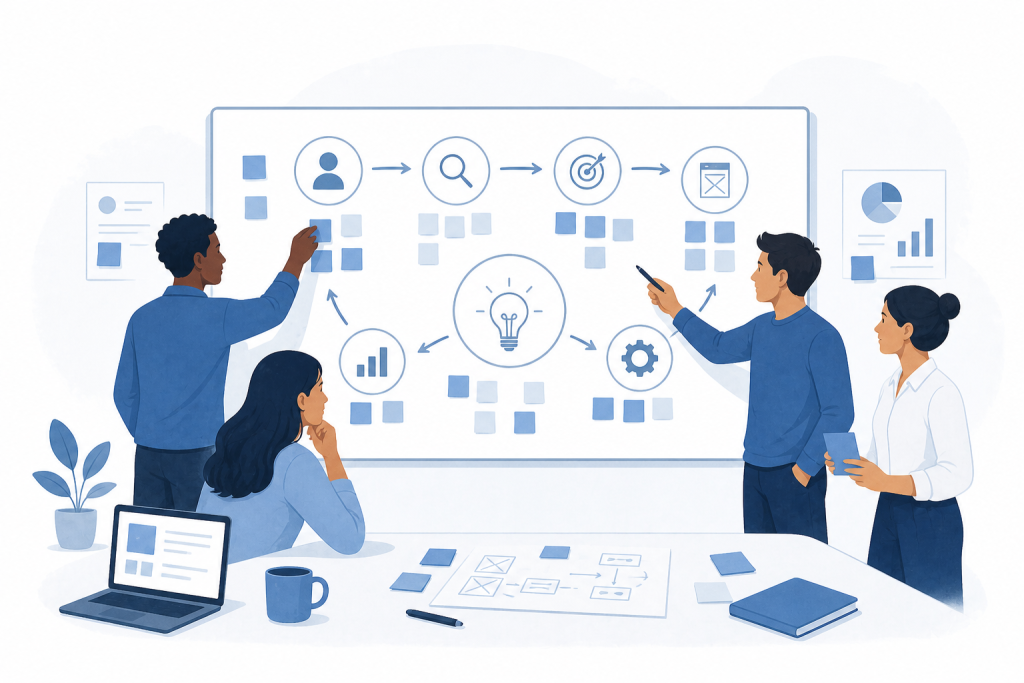
We can think of Design Thinking as a structured way to understand problems and build solutions as a group.
In practice, it usually happens through visual and collaborative dynamics: people gathered around a challenge, writing ideas on post-its, organizing perceptions on boards, sketching scenarios, grouping similar themes, discussing priorities, and transforming an open conversation into more concrete paths for action.
Instead of each person keeping their interpretation only in their own mind, this approach helps make collective thinking visible. As a result, the group can better understand the problem, compare possibilities, and move forward with greater clarity.
This process combines moments of openness, in which broader ideas and discussions are welcome, with moments of focus, in which the group organizes that breadth to arrive at something tangible and commonly understood. In Design Thinking, this is organized into moments of “diverging” and “converging.”
For this reason, the approach becomes especially relevant in alignment processes: it helps integrate different perspectives, transform scattered perceptions into actionable understandings, and build a collective mental map of the problems, challenges, and possibilities of a project.
Design Thinking as a Tool for Management, Innovation, and Alignment
Design Thinking can support the process from the initial stage, when there are still many doubts and uncertainties about what the project may become, through the intermediate stages, when more tangible elements begin to emerge and become suitable for discussion. At the end of the process, it also contributes to prioritization and to the way ideas unfold into concrete deliverables.
More than a creative methodology, it can function as a tool for management and collective alignment, allowing different perspectives to be placed on the table, visually organized, and transformed into clearer decisions.
This is where its importance for management, innovation, and team alignment comes from: when well applied, this process prevents each person from working based on an isolated interpretation of the project. Instead, the team begins to build a shared understanding of the problem, the objectives, the possible paths, and the decision criteria.
Alignment, Priority, and Decision-Making
One of the main benefits of this type of approach lies in prioritization, since when the final objective is clear, choices stop being merely disputes of opinion and start being evaluated through a central question: does this bring us closer to or further away from the expected result?
This kind of clarity is important because every project requires choices. Not everything can be done at the same time, not everything carries the same weight, and not every idea, however good it may seem, contributes directly to the main objective.
Without alignment, prioritizing becomes difficult. With alignment, decisions gain criteria.
Conclusion

One of the main benefits of this type of approach lies in prioritization, since when the final objective is clear, choices stop being merely disputes of opinion and start being evaluated through a central question: does this bring us closer to or further away from the expected result?
This kind of clarity is important because every project requires choices. Not everything can be done at the same time, not everything carries the same weight, and not every idea, however good it may seem, contributes directly to the main objective.
Without alignment, prioritizing becomes difficult. With alignment, decisions gain criteria.